

Inti Raymi Festival
To sun-worshiping Incas, the rite of Inti Raymi, a tribute to the Sun God Apu Inti Tayta, surely marked the most important date on their calendar. The winter solstice represented both the beginning of a new cycle and the return of the source of life to the Andes.
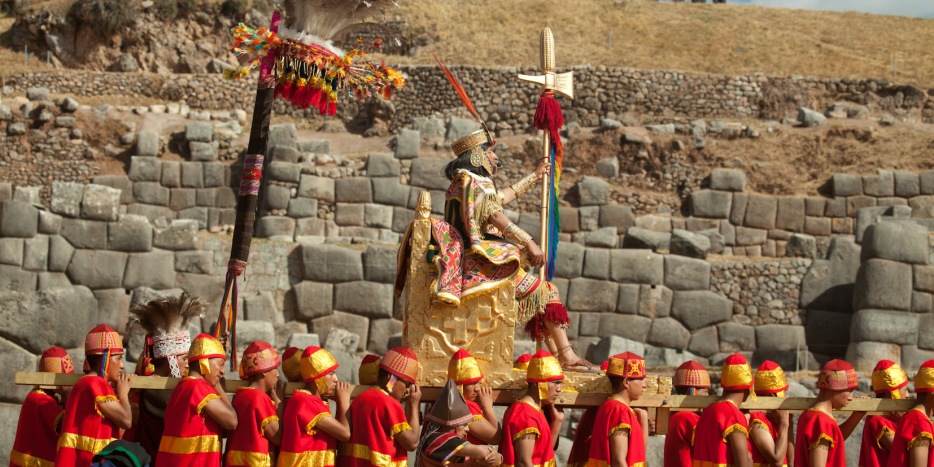
A re-enactment of this solstice celebration takes place every year on June 24 in historic Cusco, the ancient hub of the Inca’s vast empire. More than 150,000 colorfully clad natives and tourists assemble in the morning at the fabled Coricancha, or Sun Temple, where the Inca (a local resident designated to play the part) delivers an invocation of praise to Father Sun. Next, the royal entourage moves to the city’s main plaza, formerly the Incas’ great civic square. After a ceremonial reading of the sacred coca leaf to divine the future of the empire, the Inca proceeds to the massive stone walls and zigzagging ramparts of Sacsayhuaman, a cultural treasure situated on a hilltop outside of town.
With its commanding view, the ruined fortress remains one of the most astonishing megaliths of the ancient world – a single rock battlement is estimated to weigh more that 300 tons. On this occasion, the age-old stronghold is again transformed into the focus of Incan spiritual life.
The ceremony is recited in Quechua, the native tongue that is still spoken in Andean highlands. On Sacsayhuaman’s broad plaza, a fire is rekindled and a llama ritually “sacrificed” – staged out of consideration for tourists. Sounds of panpipes, drums and blaring horns fill the air. Traditional dancers representing the four corners of the empire dazzle the eye with riotous flashes of red and gold.
After the Spanish conquest, Inti Raymi was changed to coincide with the Catholic feast of St. John the Baptist. The modern re-creation, based on colonial accounts of the sacred rite, began in the 1940s as a way for Andeans to recapture the spirit and values of their ancestors. Today, Inti Raymi is one of the largest pageants in South America, and a source of great cultural pride to Peruvians.
The formal spectacle lasts just four or five hours, but for an entire week Cusco radiates renewed life and energy which recalls the glories of its Incan past.
Southwind Adventures has been designing trips around the Inti Raymi experience for over 20 years. Discover why Inti Raymi with Southwind is listed in New York Times Bestseller 1,000 Places to See Before You Die by Patricia Shultz.
Southwind trips that include Cusco’s Inti Raymi festival:
World of the Incas
Southern Highlights Tour
Inca Trail to Machu Picchu
Highlands Heritage Tour
Read our exclusive interview with Nivardo Carrillo, Inti Raymi actor on the Southwind Adventures blog
Receive Southwind’s quarterly e-newsletter with special offers! Subscribe to Chaski News